
The Sense AI Is Still Missing
AI can see, hear, and read. But there's one sense it still can't touch — and it might be the most important one.
Think about the last time a smell stopped you cold.
Maybe it was smoke before you saw flames. The faint sweetness of a gas leak you almost missed. The off note in a batch of product that saved your line from a costly recall. Or simply the moment you walked into a building and knew, before anyone told you, that something wasn’t right.
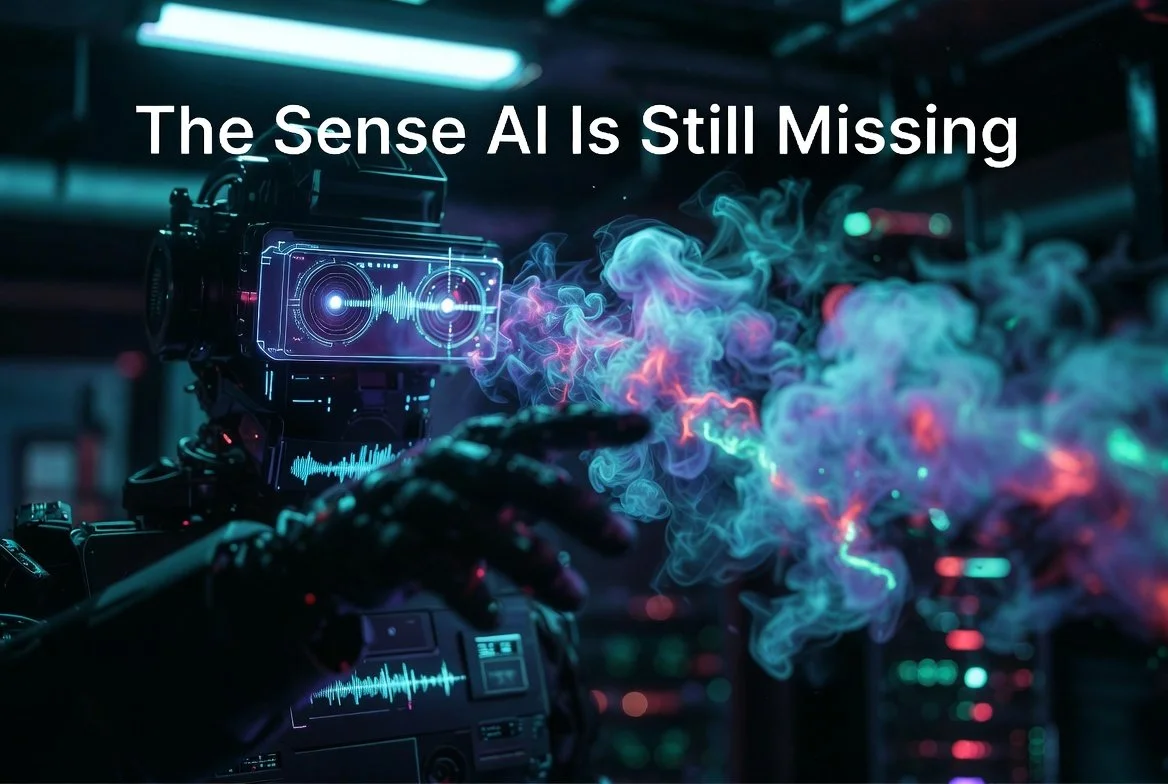
Smell is old. Older than language. Older than sight, some evolutionary biologists argue. It is the sense that plugs directly into the brain’s oldest structures — the parts that govern memory, emotion, threat detection, and survival. When something smells wrong, your body knows before your mind does.
What AI Can and Cannot Do
The last five years have been extraordinary. AI can now look at an X-ray and catch a tumor a radiologist might miss. It can listen to a customer service call and flag frustration before the rep even notices. It can read a million contracts and surface the three clauses that matter.
Vision. Hearing. Language. These are the three pillars of modern AI perception — and the investment, research, and infrastructure behind them is staggering. Cameras, microphones, and text feeds pour data into models that have become genuinely, surprisingly good.
But walk into a data center running hot. Walk into a food processing plant where contamination is building. Walk through a hospital corridor where infection is spreading. Stand near a pipeline with a slow methane leak.
“No AI will smell any of it. Not because the problem isn’t important. Because no one has built the foundational layer to make it possible.”
The Molecular World
Here is something worth sitting with: most of what matters in the physical world is invisible.
Not metaphorically. Literally. Gases, volatile organic compounds, pathogens, chemical gradients — the signals that tell you a room is dangerous, a food is spoiled, an engine is failing, a crop is diseased — these exist at the molecular level. They move through air. They carry information. And for the most part, they are completely invisible to every AI system deployed today.
This is not a niche problem. Consider what industries run on molecular intelligence right now — using human noses, expensive lab equipment, or simply hoping for the best:
Food and beverage: Spoilage, fermentation quality, contamination
Data centers and industrial facilities: Overheating components, refrigerant leaks, electrical failures
Healthcare: Early infection detection, disease biomarkers in breath, sterility verification
Agriculture: Crop disease, pest presence, soil chemistry
Logistics: Cold chain integrity, hazardous material exposure, package tampering
In each of these, smell — or more precisely, molecular composition — is carrying critical signal. And in each of these, there is no AI equivalent of the camera or the microphone. There is no standard way to capture that signal, represent it as data, and feed it to a model.
That gap is what makes this moment interesting.
Enter the LEM
The foundational unit of this new modality is something called a LEM — a Learned Olfactory Model.
Think of it as the olfactory equivalent of what a large language model is to text, or what a vision transformer is to images. A LEM is trained to recognize, classify, and reason about molecular signatures — the chemical fingerprints that everything in the physical world constantly emits.
But here is the catch: unlike images or audio, molecular data doesn’t have decades of standardized capture infrastructure behind it. There is no universally accepted “molecular camera.” Sensor hardware is fragmented. Data formats are inconsistent. Ground-truth datasets are nearly nonexistent at scale.
Before you can build intelligent olfactory models, you must build the infrastructure those models depend on. You must solve the capture problem, the data standardization problem, and the labelling problem — simultaneously.
“That is the unsexy, necessary, foundational work. And it is exactly what is missing.”
What Nosy Is Building
Nosy exists to build that infrastructure.
Not an app. Not a single sensor product. The foundational layer — the molecular data pipeline, the hardware-software interface, the training datasets, and ultimately the model architecture — that makes machine olfaction a real, deployable AI modality.
The analogy that feels closest is what ImageNet did for computer vision. Before ImageNet, vision AI was scattered, inconsistent, and unreliable. ImageNet did not just provide data — it provided a shared foundation that the entire field could build on. The breakthroughs followed.
Molecular intelligence needs its ImageNet moment. It needs standardized capture. Labelled, high-quality training data. Model architectures designed for chemical signals rather than pixels or waveforms. And deployment infrastructure that can put these capabilities where they’re needed — on the factory floor, in the server room, at the point of care.
Nosy is building that stack from the ground up.
Why Now
Two things are converging.
First, sensor hardware has finally matured enough to be deployable at scale. The cost curves have shifted. What required a laboratory instrument five years ago can now fit in a small, networked device at a fraction of the price.
Second, the AI infrastructure playbook is now well understood. The world has watched what happened when you built robust data pipelines and model architectures for vision and language. The pattern is clear. The opportunity is to run that playbook for a modality that no one has cracked yet.
“The companies and institutions that move early on molecular intelligence infrastructure will not just have a product advantage. They will have the data advantage — and in AI, data is the moat.”
The Gap Is Real
Most people have not thought about olfactory AI. It does not come up in the conversations about foundation models, infrastructure buildout, or the next wave of industrial automation.
But the gap is real, and it is large, and the physical world is full of molecular signals that no current system can read.
The sense is missing. The infrastructure to build it does not exist yet.
That’s what Nosy is here to change.
If you are building in critical infrastructure, industrial AI, or sensing technology — or if you are an investor watching the next modality take shape — we would love to hear from you. Follow along here for updates as we build, or reach out directly. This is early, and the right conversations are happening now.
